Monday, July 06, 2009

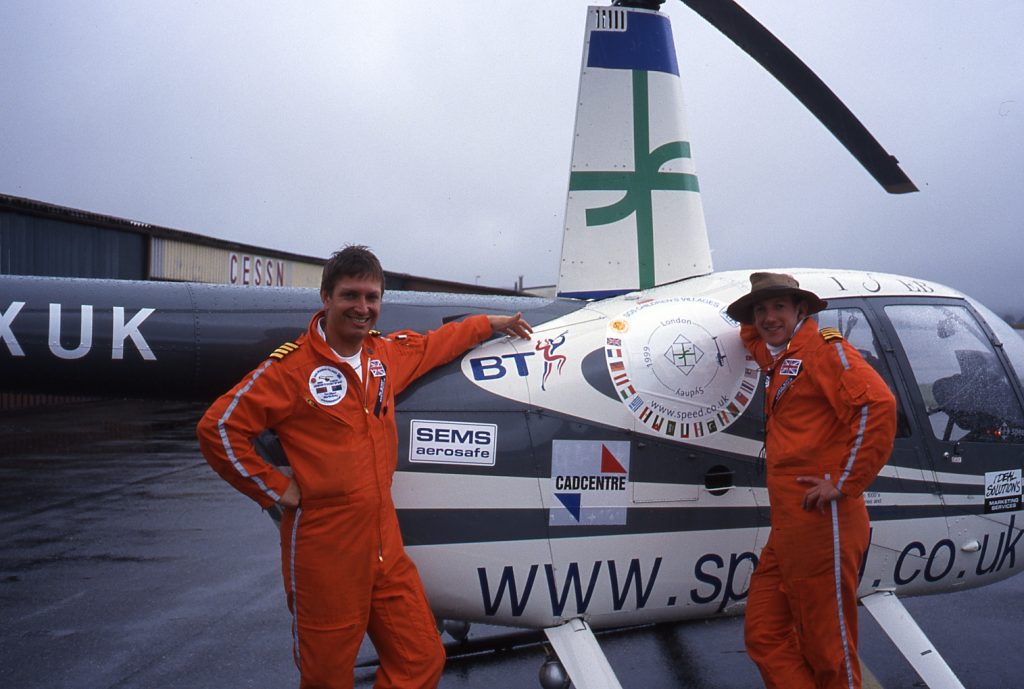
First R44 in Libya

Vangelis picked us up next morning as arranged, and we spent the morning in the control tower at Soudha trying to contact Tobruk.

We had our clearance number, but no confirmation that our flight plan had been received.

We were about to step off the edge of Europe, and this was our first real insight into the running battle we were to have with paperwork and administration over the next six weeks.

Sanctions were over, but for 20 years the outside aviation world had not been in contact with Libya, and information about phone numbers or contact frequencies was either not available or out of date. At the other end of the scale Martin had not heard from Colonel Gadaffi. We tried Air Traffic Control in Athens, and we tried the British Embassy in Libya; in each case with no luck. We tried the Libyan Embassy in Athens to see if they had any phone numbers for either the Libyan Civil Aviation Authority or Air Traffic Control at Tobruk. After a long time on hold, they gave us several phone numbers, none of which worked. We tried British Airways in Athens, who gave us particulars of their handling agent in Tripoli. We dialled the number, but couldn’t get through. British Airways helped us again, this time with the Airport Manager at Tripoli – and he gave us the frequencies.

All this took nearly three hours. At that stage the situation was that our flight plan of yesterday had not been rejected. Given Libya’s international reputation, we would have liked to be sure that it had been received, but perhaps we were asking too much. We filed another one, just in case. We had a good Cretan lunch, and decided to leave anyway.

We were out with the helicopter on the huge concrete apron when we saw the Duty Officer racing towards us in her red car. It was a message from Tobruk. This seemed to say that Tobruk was a domestic airport and we ought to contact Benghazi.

“At least it’s a reaction of some sort,” sighed Martin, who was clearly beginning to think we’d never get farther than Crete.

“I suppose with these radio frequencies we’ve got a fair chance of hearing from the Libyans soon enough to be able to turn round and come back if they don’t want us in their airspace,” I said, trying to persuade us both.

We went back to the control tower, sent another flight plan for Tobruk, this time addressing it to Benghazi, and took off.

We had tried to keep calm and business-like over all this, but there was no denying that we were pushing our luck with one of the most unpredictable regimes in the world. Communications within Libya might not be effective in letting the air defences know that at most we were a pair of harmless civilians in a miniature aircraft that could do no harm to anyone. If the worst happened we might find ourselves pursued by a flight of MIG fighters, and on the hot end of an air to air missile. Everything depended on being able to make contact using the ordinary helicopter VHF radio.

“Plus it’s a very long sea crossing, and whatever happens, it would help if the outside world knew roughly where we are,” Martin had said, as we had tried to weigh everything up.

The European mobile phone system extends only half way across the Med and our satellite phone works well only on land. In an emergency we would be relying on the mayday signals from the watch lent to me by Mappin & Webb, and who could guess the range of this. So we were unusually nervous on the flight. The weather was good, sunny with no cloud, next-to-no headwind; the sea calm with very little in the way of swell, and the temperature around 30 degrees at just over 1000 feet.

We passed over the island of Gardhas just 25 miles south of Crete, which is supposed to be the southernmost point of Europe, and Martin began to speculate that with his visit last year to Cap de Roc in Portugal, the most western point, he now only needed to look in on somewhere in Northern Norway, and somewhere in the east, to have done all four corners of the continent. This kept us occupied for a while as we headed towards the midway point.

We drank some more water.

Suddenly returning to reality, we realised we were indeed practically half way across, and on the point of entering Libyan airspace. We tried all the frequencies we’d been given, but without response. This was not good news, but not surprising, because the VHF, like light, is line of sight, and at 1000 feet the curvature of the earth soon cuts you off both from anyone listening and from any transmissions.

We had seen no ships whatever since we left Crete.

We thought again that it might be an idea if someone could at least know where we were, so we began to send out signals that other aircraft might pick up. We used the international distress frequency on 121.5mhz, making clear that we weren’t in distress but were just sending a practice signal.

It worked. A German airliner, seven miles above us, called us back.

“Hello. This is Germania 409, calling on 121.5. Can I help you?” A really beautiful German tenor voice, set against the soft background hiss of his radio.

“Good afternoon Germania 409. We are a helicopter on a VFR flight, Golf, Bravo, X-ray, Uniform, Kilo. We are heading from Crete to Libya Tobruk as booked and planned. Our current position is 87 miles south east of Soudha in Crete. We are seeking to establish radio contact with anybody else. Nice to hear you.”

There was a pause. They were probably asking each other if they’d heard us right, I thought.

“Shall we transmit something to any place?”

“If you are able to contact Libyan airspace, 120.9, and tell them we have passed their Flight Information Region boundary, and we are now in their airspace, that would be very useful.”

“I will try Athens.”

He came back in a few minutes.

“Athene want you to contact 130.9, Cairo.”

Athens, or Athene, obviously thought we were also an airliner at 37000 feet, to suggest that we call an airport 300 miles away. The higher you are, the further your radio reaches. There was no way we could get contact with Cairo from a height of 1000 feet. But we tried three times just to show willing.

We reported this back to Germania 409. He undertook to talk to Cairo, and then to Libya. No result.

I was by now distinctly worried at getting very close to Libyan territorial waters, where the prospect of being greeted by a hostile Libyan MIG fighter was looming large in my minds. Out of the blue we got a call from a Sabena airliner, whose operator also got to work on the problem. He quickly succeeded, being much higher in the sky than we were.

“118.5 correct frequency, call them.”

Feeling rather self-conscious, I called, “Libya, this is Civilian Helicopter Golf, Bravo, X-ray, Uniform, Kilo.”

“Ah, Uniform Kilo, we have been expecting you.”

I gave him our Estimated Time of Arrival, and told him our position. He acknowledged, and I said we would be in touch again later.

We could now feel certain that we were not going to be blasted out of the air, but it remained to be seen what sort of welcome we would be getting. For now we turned up the cd player and drank some more water.

We flew on, soon crossing the coastline where fingers of rocky yellow sand reached out into the bright blue sea, following the line on the GPS screen which we thought would take us to Tobruk Airport. Moments later, we saw the famous harbour in the distance. The GPS was telling us we were overhead the airfield, but there was nothing but sand beneath us.

“Hang on, I can see an outline of a taxi-way down there” said Martin suddenly as we circled round the dot on the GPS. “ It’s covered in sand. Call them and ask if they think we’re overhead”.

“Er, Tobruk, can you see us overhead?” I suggested on the radio.

“Head for El Nasser, 25 miles south of you. You are cleared in.”

El Nasser? From the look of the map it’s a Libyan military base – surely there was some mistake? And what did “We have been expecting you” mean?

I checked that they really meant El Nasser, and they confirmed. They sounded businesslike. El Nasser it was. Tobruk Airport itself obviously had been abandoned to the desert some time ago, and no-one had updated the maps.

El Nasser is about 25 miles south of Tobruk in the yellow sand of the desert. We had maps to cover it, but they weren’t much help. They looked like sheets of sandpaper, as did the ground below us.

It’s an operational military base, with long runways, buildings, aprons, the whole nine yards, all surrounded by a wall, a very long wall indeed, in the form of a square. The wall must be to keep out Bedouins and camels, or even the wind-blown sand.

I kept the camera filming for as long as I dared. This was the kind of thing I wanted to film, but it was the kind of place where it would get me into most trouble.

“Turn that frigging thing off and put it in your bag,” insisted Martin as we turned onto final approach, no doubt remembering the trouble we’d had in Corfu. “We’re landing on a secret military base in a police state.”

He was right, of course, and I did so, crestfallen that I was about to miss the best bit of action so far. But it wasn’t worth getting arrested for.

We hover-taxied to the apron in front of the terminal, looking round at the rusting corrugated iron hangars and the heaps of ageing military hardware decaying on the side of the taxiway.

We followed the air traffic controller’s instructions and he put us down not far from the tower.

The tower was modern and western in style, though incongruous, attached as it was to a small terminal building in the style of a mosque.

The whole place shimmered in the desert heat.

We took a last drink of Cretan bottled water, both wondering what we’d let ourselves in for. No-one had done this before, not since the battles with America, not since the UN sanctions, not since the Lockerbie bomb, not since the murder of the WPC shot in London.

We had naively come in peace and friendship, and suddenly felt a very long way from home and safety.

A white Toyota Landcruiser came racing out to us, gleaming in the brilliant sunshine, and I got out to meet it. A burly and authoritative figure in lightweight olive green battledress and dark green beret, complete with elaborate swagger-stick, climbed down from the Landcruiser, and we seemed suddenly to be surrounded by heavily armed guards, their eyes dark and narrowed against the sun.

My mouth was dry, as I watched the big man straighten himself up, and turn in my direction.

He came forward towards me, a haughty, senior officer look on his face. I wasn’t sure about all of this, and I briefly considered a few options, including getting back into the helicopter and flying off.

As he squared up to me, less than two paces from me, his face cracked into a broad smile. He shook my hand.

“Welcome to Libya. I am a personal friend of Colonel Gadaffi, and you are the welcome guests of the Libyan Government.”

He was the officer commanding the airbase, Colonel Sager, he told me.

I wanted to pinch myself, catching myself thinking how much like a James Bond film this must look like. I was very relieved to find that we were actually welcome.

To my embarrassment, Colonel Sagar then made a short speech. Consulting his notes he said that this was a historic moment, as we were the first British pilots ever to land at El Nasser airbase (not strictly true, I thought to myself, as the RAF had built it) and that we were the first civil aviation aircraft to cross from Crete in 40 years. Our arrival had been keenly anticipated and our journey had been followed on the radar ever since we left Crete. He concluded with a renewed welcome, and introduced his two companions, Lieutenant Colonel Mufta and Major Joma. I assessed them discreetly as I shook their hands. Secret police.

Engineers appeared, carrying a barrel of what looked like fuel, and a handpump. I hoped it was fresh and clean, but couldn’t think of a polite way of asking. It was at least the right colour. The pump looked as though it could be the real threat to our helicopter, covered in rust, cobwebs, and flakey paint. Martin stood beside me, and together we watched the procedure, both accepting the fuel in quiet gratitude and wondering if our engine would feel the same.

The fuelling complete, the Landcruiser took us to the control tower, where the Colonel shook hands again, and left us. His armed bodyguards went off with him.

Major Joma took us to our hotel, and booked us in. He explained that our living expenses were to be met by the Libyan Government. The helicopter was to be guarded by his soldiers. The Avgas fuel was also to be free of charge. Everything would be paid for by the Libyan Government.

“We pick you up after breakfast and take you on tour as guest of Colonel Sager,” he commanded. There didn’t seem to be a choice, and anyway it sounded great. There would perhaps be worries about our timetable, and some of our visas for later in the journey were valid only for certain times. But all we could do was go along.

I was stunned, trying to take it all in. It’s not everyone visiting an unfriendly country who is offered a formal speech of welcome, however short, from a senior military officer, and free hospitality and refueling. It was all such a complete contrast with what we had expected and feared.

We did our best to express our appreciation to Major Joma, and indicated that we felt honoured to be received in this way.

The hotel was ranked as five star. I left my bags by the un-manned Reception desk, and took a look round to get a feel for the place. It was huge, ugly, British- built in concrete in the late ‘70s, with a very generous reception area with lots of chrome fittings and smoked glass, a bar with no alcohol, a restaurant with a choice of one meal, a swimming pool with no water, a tourist office with no leaflets, and 300 rooms. It seemed to be staffed exclusively by men, and the toilet arrangements for guests catered for men only. It turned out that only about 20 rooms were occupied, mostly by European oil-workers.

We checked in, and made our way upstairs to our rooms, which were clean but scruffy.

Our first priority after a shower was to contact home.

There was no phone in the room, so I set up the satellite phone on the window sill of the room, turning the aerial slowly until I found a strong signal, apprehensive that using this equipment in Libya was probably punishable by death.

We spoke briefly to James to let him know that we were in Libya, safe and sound.

After a brief conversation, the signal on the sat-phone closed, as the satellite disappeared over the horizon, and I was left feeling very bad that we had lost the opportunity to speak directly to our families. I was suddenly beginning to feel a very long way from home.

The restaurant, which overlooked the harbour, was full of Western men, and staffed by Libyan men. There were no women or children. The waiter stood by us, pen poised over his little pad, just like he would at home. I looked at the menu he’d given us, while he stood there waiting for me to choose. The choice, as offered to us by the menu, was a single line of Arabic. I had no idea what it said, and the waiter could not tell me. I pointed to it, said ok and nodded at him with a smile. He nodded back, as if to say “Good choice!” Waiters, like taxi drivers, seem to be the same the world over.

Martin did the same, and we waited to see what would arrive. We were suddenly starving, as we relaxed from the tension and heat of the day.

Looking around, I could see everyone eating a kind of soup, which offered a clue as to what to expect.

The food was not nearly as Arabic as I’d imagined it would be - more Italian, as influenced by Libya’s colonial past. The soup was a kind of minestrone with risoni, and we pitched into it hungrily, trying not to spill it on our white flying suits. It was appetizing stuff and there was plenty of it.

“Whatever it is, it looks like maggots in tomato sauce”, said Martin, not letting the thought stop him from going on to a second bowl.

I thought back to Martin’s Mum and Dad’s place, in south east London, where, as a teenager I’d always been welcome to stay for meals as they arose. “There’s a spare dinner in the oven if you want it,” his Mum would always say kindly to me, as we came in from the garage, usually covered in oil from taking a bicycle or motorbike apart.

The food at their family home was always very reliable, filling, and traditional British, meat, gravy and two veg, on a Denby plate. There was always a pudding, with custard, to follow.

His Dad, a family doctor, would occasionally indulge us with some of his home made beer, brewed in the basement.

All that seemed a long way away, as I sat twenty years later with Martin in a hotel in Libya, overlooking the harbour at Tobruk.

That night, I slept uneasily, grateful for the hospitality, but unable to believe it enough to relax, and wondering what the next day would reveal.

Major Joma was there at breakfast, dark, chic and athletic in his trainers, and somehow compact.

“Colonel Sager send his regards, and orders me to make you enjoy day,” he smiled, full of promise, but wary. He obviously did not trust us an inch.

He suggested, for our morning tour, the English and German war cemeteries from World War II. Then he would give us lunch at his house. And afterwards he would take us on a tour of Tobruk town and its surroundings. Cemeteries weren’t a usual passion of ours, but we accepted happily, and set out in Colonel Sager’s Landcruiser, loaned to us for the day.

Military cemeteries are not to everyone’s taste, but these are beautiful and impressive, as well as distressing. Unimaginable numbers of young men, killed in battle at ages between 18 and 22, lie buried here, in the immaculate British and Commonwealth cemeteries recorded by row upon row upon row of individual gravestones. The Cemeteries retain the name used by the British to identify areas of featureless sand where battles had been fought; the one we visited had the name “Kensington” engraved on the elaborate sandstone archway over the entrance.

The German cemetery, by contrast, was in the shape of a huge medieval castle, clearly designed to last forever, built on the ridge above Tobruk town, poignantly commanding the best view of the town in military terms. The remains of the German dead, collected from the surrounding desert in the 10 years after the war by German recovery teams, had been placed in a massive pit in the castle’s courtyard. Their owners’ names were inscribed in granite, thousands of them, on arches around the great square stone courtyard.

Bizarrely, the key to the castle was held by a scruffy local who lived with dozens of similar families encamped in a dusty settlement at the foot of the castle walls. Overhead, a rusty pylon buzzed and crackled through sheer lack of maintenance. The old key was huge and black and heavy. The door was reluctant to open, despite the efforts of Lt Col Muftah, the less cheerful of our escorts.

Martin couldn’t help himself. Indicating with a sweep of his arm the castle and the Arab desert behind it, he advised cheerfully:

“You must say, Open Sesame!”

Lt Col Muftah, up to this point, had played things pretty cool with us. He had been making it clear no doubt that he had hard evidence that we were enemy spies and a threat to both public order and national security. Now he looked up from his work with the key, straightened up, and levelled his gaze at Martin. There was a tense moment, while he studied Martin’s friendly smiling face.

After a very long pause, abruptly he reached out with his hand to shake Martin’s, laughing and sharing the joke. This was a turning point, and they relaxed their guard with us, just slightly, from that moment.

The rights and wrongs of war, and of the Libyan campaign in the Second World War in particular, formed a major topic of our hosts’ conversation. Perhaps they thought that as skilled helicopter pilots we must have some undeclared military background, and would therefore be especially interested.

“Hundreds, thousands of young people died and for what? For miles and miles of empty sand! Desert lands that are not yours, not the Italians’ not the Germans’ to fight over? And remember, lots of Libyans killed, too.”

This was not expressed as if there is continuing resentment, but there was an enduring exasperation. They asked us how we would feel if Arab armies came to England to fight their tank battles. It seemed like a fair point, really, and not one which we could answer.

This was said in the context of their general resentment about being treated by the West, and the USA in particular, as an inferior culture.

Their assumption that we were paid by our Government to come to Libya was unshakeable, and probably accounted for their keenness to get us to lobby on their behalf with the Americans.

Leaving the old key with its guardian, we drove back to the airbase to visit Major Joma’s three small children at his home on the airbase, where we were given lunch. We enjoyed meeting them before they were hidden from view, and it set off a long talk about our own families, what they all liked and did and hoped to do; and passing round photographs. Lieutenant Colonel Muftah produced from his wallet pictures of his eight children.

The meal was formal Arabic, eaten sitting on the floor, and we noticed that Major Joma’s wife kept herself out of sight. She did appear, though, for a brief instant when we asked, and we were able to offer her our thanks for the hospitality before she quickly vanished back behind the scenes. This was obviously a clear breach of etiquette, but in the privacy of Major Joma’s home it appeared to be acceptable.

A tour, in the Landcruiser, of Tobruk town and the surroundings took up the afternoon, and this reinforced the strangeness to me of the role of women. The streets, with by our standards not much traffic, were an ideal playground. But for boys only. There was not a girl in sight. And women were not to be seen shopping; indeed the notion of recreational shopping whether by women or men did not seem part of the culture. I asked if we were allowed to go shopping in the rather thin looking bazaar.

“What you want?”

“Er, it’s not that I want anything, it’s just that I’d like to go shopping”.

There was an exchange in Arabic. This was either forbidden, or incomprehensible to them, or both. Without a further word, they sped off through the narrow streets, scattering as they did so shoppers, traders, produce, and goats, as the huge car dominated the narrow streets of the old town. We stopped a shop which had a government-run look about it.

“Wait here!” commanded Lt Col Muftah.

Minutes later, he returned with a brown paper bag containing two bottles of Libyan aftershave.

“For our British guests!” he said.

I thanked him profusely, and didn’t repeat my request to go shopping.

Many of the actual buildings of Tobruk, a town of 100,000 inhabitants, are made of whitewashed concrete, usually three or four storeys high. Perhaps because of all the dust blowing in from the desert, they do not give an impression of prosperity, though of course internal courtyards may tell a different story. We saw no old buildings, no public telephones, no parks. Shops were open fronted, bazaar style. We went past a mosque and a friendly-looking school. There was no vandalism and no graffiti.

The town is a port for the export of oil, and sanctions must have had a severe effect. The only other economic activity seemed to be some subsistence farming. The airbase may perhaps have helped too, though Major Joma’s delightful home, with its shady well-watered courtyard, planted with lime trees and flowers, was situated in a development related to the airbase rather than to the town: and the standard of living of the armed services, and senior officers in particular, may possibly be supported by some privileged system of distribution which would by-pass the shops in the town. We thought this was probably true at least of his elaborate satellite television and the rich fabrics and rugs.

The town had no roundabouts or traffic lights, and there seemed to be no rule about which side of the road to drive on. At junctions, whoever had the biggest car, the most stars on their shoulders or the ability to stand on their horn for the longest, took priority. At one boundary of the town we were stopped at a military checkpoint. Soldiers pointed Russian-made semi-automatic weapons at us. We were pleased as Westerners to be accompanied by our minders and were quickly waved through.

Major Joma was again with us at breakfast at the hotel, to smooth our departure, but he was unable to divert the hotel’s tourism adviser at the hotel. This delayed us for half an hour, while this earnest man told us all about his country, the culture, and the warmth and friendliness of the Libyan nation.

“Please tell all your people to come here as holiday,” he urged us with sincerity, elevating us to the status of some kind of popular leader.

Looking around me, I thought that for some people who had a compelling reason to come, such as relatives of servicemen buried in Libya, or people who see themselves as travellers rather than tourists, Libya has things to offer, but for mass tourism it has a bit of a way to go. I tried to imagine Club 18-30 applying for planning permission, or Saga Holidays sending in a luxury coach full of blue rinse ladies from Harrogate.

At the airport, we went to the briefing room and found we had clearance for Alexandria. The R44 was already fuelled and checked over. We shook hands all round, wished a special goodbye to Major Jomah and Lt Col Muftah, left our good wishes for Colonel Sagar,and took off heading east.

“You can’t go into Libya,” people had said beforehand. We’d done it, and we had been welcomed by a Government now perhaps anxious to change its image with the Western world.

I was personally very relieved, though, to be getting out of Libya. Getting in had been very stressful: our stay there, accompanied all the time, was not much less so. What we needed now was a calm and hassle-free day. The direct route from El Nasser to Alexandria, into which we were cleared, runs more or less along the coast, so we followed that, monitoring our progress on the GPS.

Friday, July 03, 2009

Egypt

From Tobruk to the Egyptian border is around 70 or 80 miles; as far again inside Egypt is Sidi Barrani, followed by Mersa Matruh, and then Alexandria, another 150 miles or so altogether.

In places the coast is ruggedly beautiful, with groups of narrow headlands and bays punctuating flat sandy beaches that stretch for miles. The land looks uninhabited, though there are signs of cultivation as you move into Egypt, and roads. We did see one person who waved – and one small fishing boat on the intensely emerald sea.

World War II fortifications were scattered about, incongruous in the natural beauty.

At a place in the middle of nowhere, delightfully called Buk Buk, we began to hear radio signals from, we thought, Sidi Barrani. We could not raise them, probably as we were so low, skimming along just above the gentle waves as they met the baking sand of the beach. We tried Cairo, with no success there either: we were just too far from anywhere.

We saw very young soldiers patrolling the beach, armed with rifles. Most ignored us. One took cover. Suddenly, as we rounded a gentle sandy headland, one of these young soldiers raised his rifle and took aim. I threw the helicopter out to sea in a violent left turn, to put the solid block of the engine between me and his gun, and to get out of range. After that, we flew on, farther out to sea.

We made contact with Mersa Matruh at 30 miles to the west of it and they cleared us through their airspace, no problem. They gave us 130.9 as the Alexandria frequency and reported our position for us. The town itself looked prosperous, a contrast with Libya, and there were increasing signs of tourism and leisure as we moved farther along the coast. People swimming in the sea waved at us as we went by. The atmosphere had changed. This was again a prosperous and free western-style society.

We went on, looking for a place to land, take photos, and take a break. After several attempts, we found a likely looking beach to put down on, desperate to relieve ourselves, and hoping no-one would see us or point a rifle at us. We still needed to feel convinced that things had changed.

I had just cut the helicopter's engine, when Martin pointed to a group of twenty or so figures running towards us up the beach. They were far enough away for us not to be able to tell whether or not they were armed.

“Sod it, there won’t be any guns - this is Egypt, you can come here for your holidays”, I said. I got out hurriedly. If I was going to be arrested, at least I was going to have relieved myself first. There was just time.

But we needn’t have worried. We were being approached by friendly educated Egyptian tourists shaking our hands, smiling, taking photos, and using camcorders on us. That helped wipe away the last traces of the militaristic cold war atmosphere that lingered on with us from Libya.

“Love your Robinson,” they shouted in smiling approval, clearly no strangers to American luxury brands. One of them said he ran a casino in Cairo.

We took off within ten minutes, leaving a group of new friends.

Later as we approached Alexandria, we got into the air traffic control system, and asked for a particular course, one that would take us close to the pyramids for a bit of aerial tourism. This was refused. But a minute or two later we were called and given the course we wanted. Perhaps it was good nature triumphing over the rules. We got a great view, and we took some good photos. The air pollution, a mixture of desert sand and exhaust fumes, gave the printed images a rather surreal appearance.

We stopped at Alexandria for fuel and formalities, and it took forever. The service was slow in spite of the enormous number of people involved at every stage. There were 37 people standing around our helicopter as it was refuelled, and only two of them were necessary to carry out the work. We could tell that we represented dollars for these people, and that they were all hoping for a cut. The handling agent, whose job it is to smooth our way through the airport and its procedures, was corrupt and greedy. Worse still, the food looked dangerously unrefrigerated and expensive, and the bottled water had a suspiciously insecure cap.

Worst of all, their greedy inefficiency stole precious and irreplaceable time from us.

The area stank of oil pollution from the nearby coastline, and we couldn’t wait to get back into the air and get away. Our aim for the day was to reach Aqaba in southern Jordan, and if we could do that we would have made up the time lost being entertained in Libya.

We flew down the west coast of the Gulf of Suez, where a range of low mountains runs north-south along the Gulf. We stopped to take some photos of the harsh and impressive landscape. The ground, made up of what looked like small pumice stones, burnt our feet through our shoes. We seemed to be the only living thing visible from horizon to horizon. Our helicopter stood there looking like an Apollo landing craft on the moon.

At that point, we suddenly realised that the sun was touching the horizon behind us. We were more than 20 degrees farther south than when we started out from home, so it got dark much earlier than we were used to in the UK. And because we were much closer to the tropics the days were ending without much in the way of twilight. We should have taken all this into account, and kept going, rather than wasting time taking photos and drinking Coke.

In the air again over the eastern coast of the Gulf, and looking at the map on my knee, I talked this through with Martin:

“We’ve really fluffed this up. It's getting dark already, and we've got an hour and 10 minutes flying to do, across uninhabited desert and uninhabited 3600 ft mountains. A forced landing in that kind of terrain in the dark would be unsurviveable. Then if we do get over the mountains, we're looking at a night landing at Aqaba, which we could probably manage if we had a copy of the approach procedure to hand, which we haven’t. On the approach path to Aqaba International Airport you have less than a mile to play with or you stray into Israeli airspace, and you can imagine what kind of firepower that might let loose.”

“Yes, I see what you mean,” said Martin. “Is there anywhere round here we could land instead?”

I looked down at the map.

“There's some kind of military airport on the coast marked here just south of the town, but I can't see anything at all that looks like a runway down on the ground. Other than that, there's no airport closer than the one we've just come from.”

We didn’t fancy returning to Alexandria, and in any case, we had used more than half our fuel, so couldn’t get back there anyway.

By now, lights were coming on in the town we'd just flown over, as darkness began to fall.

“I thought I spotted a hotel on the coast back there, with parasols and stuff on the beach.” I ventured.

We turned round to go and find it, gagging for a cold beer in the hotel bar, not having had any kind of alcohol since Crete, which seemed half a world ago.

Halfway back to the coast we saw a dusty compound, surrounded by what looked like whitewashed chalets and a high wall. From 1000 ft it looked like it could have been some kind of motel, so we thought we’d try it. Martin put the helicopter into a steep descending turn to the right for a closer look.

“Not sure that’ll do us,” I said as we got really low. “Er, it looks like a police station.” There was a guard house, armed guards, a flag-pole with the national flag, and even an armoured jeep.

“Better get away from this,” I suggested “before we get shot down”.

Martin pulled up sharply and headed back for the hotel I had seen on the coast. It certainly looked more promising, with an elaborate sunshade over the front door, and sun-worship paraphernalia to the rear of the hotel on the beach. It had everything a hotel should have, but we felt there was something odd.

The immediate neighbourhood, indeed the whole town, was a dusty staging post on the main road heading north-south along the coast. It might even have been partly military in origin. In the main square beneath us we could see ancient juggernauts, elaborately decorated by hand in the style of the local mosques. Most of the streets were just sandy trails leading down to the sea from the main road half-a-mile inland, edged with low concrete houses, their boundaries marked by what looked distinctly like discarded tank caterpillar tracks. These prompted another doubt; this part of Sinai not so long ago was a war-zone.

Not really tourist hotel territory at all.

“Beach clear of wires and people!” I confirmed, as Martin approached the beach flying low over the sea. This is one of the safety rituals we had developed over the years to avoid the many simple mistakes which can spoil a nice day out in a helicopter.

“Thanks,” said Martin, “I'll put it down on the sand next to the beach entrance then. Watch the tail for me as we settle. The sand looks very soft so we might sink in.”

With the machine hovering, I opened the door to watch the tail rotor at the far end of the helicopter. It's the most vulnerable part of the helicopter, being relatively close to the ground, and out of sight of the pilot, as well as the most threatening to onlookers for similar reasons. The skids settled far into the fine dusty sand of the beach before we stopped finally. The tail was inches from the sand, but safe enough.

As we looked around us, waiting for the engine to cool, we could tell for sure that something was not right. At least a hundred young people, definitely not hotel tourists, were lined up along the boundary wall of the hotel watching our arrival.

“It looks more like some sort of youth hostel,” said Martin.

I opened the door again to get out onto the hot beach. No longer blown away by the downdraught of the rotors, dozens of flies poured in to check out the cockpit for food, stopping only briefly to land on our lips and in our eyes.

It turned out that we’d landed at the Institute for Tourism and Hotel Studies, where hotel and tourism skills are taught to the teenagers who now crowded round us.

We were welcomed by the Manager, and this welcome was followed by visits from the police, the military, the plain clothes men and a few others, all of them wanting to photocopy just about every document we had, including our fuel receipt from Alexandria and Martin’s Warranty Certificate for his water purifier. Once they had done all this they departed, friendly and content, and everyone chatted happily with us. Another squad, this time from the Navy, turned up just as we were half way through our meal. We exchanged friendly words and they too left happy.

After supper, a young tourism student called Hani took us round the town, El Rashid, showing us the shops, the bars for tourists, the cafes, and the neat but sandy gardens. An enthusiast for tourism in his country, he was a good guide. But he didn't want to talk about the tank tracks.

“I take you to restaurant, very nice, very nice” he promised. “All your friends from England can come next time, you tell them,” he implored, pausing in between every other word to brush away all the flies gathered around his mouth.

“I’ll certainly tell them,” I promised politely, doing the same.

The restaurant was a Sinai roadside diner, which sold only coffee and cigarettes at that time of night. We bought some, and chatted as best we could with the lorry drivers, Hani doing the interpreting.

I slept really well, much better than in Libya, where there was always a feeling that we were being treated with suspicion, and that they were keen to control and monitor our every move.

Wednesday, July 01, 2009

Robinson R44 in Jordan

Before we took off for Aqaba we needed to file a flight plan. I sat down with my mobile, and tried to work out how to say “Can I file a flight plan, please” in Arabic. It wasn’t in the phrasebook, but I managed to get a result in the end, mainly in English. But then the local army began to take an interest, and a small well disciplined squad consisting of a Major, two heavily armed soldiers, and two civilians with guns, all marched up, in step, to ensure that everything was in order, halting smartly at the Major’s command.
Cairo air traffic control assured us on the phone that no further permissions were required from an aviation point of view. The Major demanded to see a fax to that effect. Cairo refused to send one. In the end I showed him a completely unrelated fax about Libya, which seemed to satisfy his requirements, or perhaps his dignity.
Delayed by an hour and a half, we climbed away towards Aqaba, 120 miles to the east.
The Sinai Peninsula, which we had to cross to get to Aqaba, has mountains, including Mt Sinai, that rise to 8500 feet. Using the valleys you can get across it, though, without flying much above 3000 feet, but we flew at 5000 feet anyway because of the heat. At that height, the temperature in the cabin was just about bearable. The landscape is golden and rugged, sandstone and scrub, cut across north/south with dry water-courses. It was a flight we were happy not to have done in the dark, because if anything went wrong landing in the dark would definitely have killed us.
When we were within 10 miles or so of the Gulf of Aqaba we had to take care to fly well south of Eilat, because we had no clearance for Israeli airspace, and they’d be entitled to shoot us down.
We flew carefully along the edge of the Israeli zone, using the GPS. Suddenly, the helicopter rocked sharply as the wake of another aircraft hit us. At the same moment, we saw him flash past us, a modern jet fighter. He was flying in the same direction as us, slightly above, on his side in a long turn around us, passing close enough for us to see the detail of his flightsuit, and to hear the roar of his engines. I spotted tiny blue Stars of David against the desert camouflage pattern on the stubby wings. We rocked again as a second jet roared past a few seconds later. I reported our position to the controller at Aqaba. He made no mention of the Israeli supervision. Nor did I.
The jets made one more pass, this time farther away and slightly below us.
I double checked our position, to be certain that we were legally outside Israel’s airspace.
“It all looks ok”, I confirmed to Martin, “though I suppose it must look a bit unusual to them to see a British registered civilian private helicopter passing their way.”
We also wanted to avoid straying across the Saudi border, only 15 miles or so south of Aqaba. The air traffic controller’s first question whenever we spoke to him was to ask if we were still in Jordanian airspace. In each case we were, and we made it into the airport without incident, to be marshalled to land next to a gleaming British Airways Concorde. From our tiny little aircraft I looked out at it and reflected that it was really quite small as airliners go.
As the rotors were slowing to a stop, Martin’s door was opened from the outside.
“Hi, you’re a long way from home!” It was a British Airways stewardess from Concorde. Martin made a huge fuss of her while she listened to his explanations of what all the complicated controls were for. She smiled indulgently at him, unimpressed, and wished us luck.
Once we’d refuelled, a Dr Faisil, the Director of the SOS Children’s Village at Aqaba, met us at the airport building. The charity was becoming more and more interested in us as a tool for generating Press interest, and had been in touch with James to find out more about our route.
“Can we visit your Village?” I asked, keen to make the effort for anyone who had made an effort to welcome us. “We’ve got a couple of hours before we have to be on our way to Amman.”
It was just up the road. We met the children, and their adoptive “Mommas” who run each house, and admired the handsome stone domestic buildings set among orange trees and landscaped with neat bougainvillea, irises and succulents. We drank Turkish coffee. The children, and the Mommas, loved being filmed with my video camera, and the children loved watching themselves on the camera screen. They all waved us goodbye and we set off back to the airport.
We flew on to Amman, which took us about an hour and a half. SOS, now seriously interested in us, had a car waiting to take us to another of their press conferences.
All of those interviewing us for the press and TV were women, offering a stark and welcome contrast with the restricted role of women in Libya. We did our best for the charity, giving interviews to each of the TV, radio and press groups represented there. We explained, having been hastily briefed, why we were interested in SOS Children’s Villages, our route from England to Australia, the record we hoped to achieve, and how we were aiming to raise the profile of the excellent work done for the orphans. We expressed our admiration for the Children’s Village we’d just seen at Aqaba. The Jordan Director for SOS Villages, Lina Kopti, organised it, and made it all run smoothly.
In the evening, Lina and her husband Owni, a sophisticated and metropolitan couple, generously took us out for dinner along with a group of friends connected with SOS.
It was an awesome party under the stars. The restaurant was a 100 year old merchant’s house deep in the old part of the city which tourists never get to, and we ate outside by candlelight under a liana-covered loggia, sensing warm aromas of spices and flowers, wafted around us by the warm breeze from the nearby desert.
The meal was one course after another of delicious Mediterranean food. Salad, vegetables, dips, lemons, spicy yoghurt, salsa and raw meats, including diced raw liver.
“Very good for your blood,” insisted Owni, a medical consultant, as he saw me hesitate.
“Yes, but is it safe for a British helicopter pilot with no lavatory in his helicopter?” I very nearly said, before trying it. Getting ill was still my main fear, as we couldn’t very well stop every five minutes in the desert.
You spike the small cube of liver with a cocktail stick, dip it in a ground spice, which sticks to the glistening sheen of blood, and chew. Actually I loved it, fully expecting the next course to be sheep’s eyes, and completely certain that I’d be hideously ill all night and for weeks. And I’d left all the medicines in the helicopter.
Ramas, the Koptis’ bright sixteen year old son, was aiming to become a pilot and I talked to him about that. I found him extremely well informed about aviation and keen to get some hand-on experience, though of course at that age there’s not much you’re legally able to do. He made a really enjoyable companion. The meal finished with coffee, served by a man dressed as an Arab warrior. He brought in a tall coffee pot and poured the coffee out with astonishing accuracy from a great height into a tiny cup.
Back at the hotel, Martin said he thought he’d see if he could find a late night chemist before turning in. He was walking oddly, and not looking at all well. I offered help.
“I’ll be fine, mate, you get some sleep,” he said.
At breakfast the next day, he was still a peculiar colour and we decided that this should be a day for chilling in the relative comfort of our hotel, the Marriott, and perhaps doing a spot of tourism.
We spent part of the morning in the extensive reception area of the Marriott, with Ramas acting as interpreter, phoning ahead for fuel. We made no progress, other than vague hints that we might be able to get some Avgas when we got back to Aqaba, and then beyond that in Saudi Arabia. The real problem turned out to be that leisure flying in Saudi Arabia uses jets, partly because the Saudis can afford them, and so there is little demand for piston-engine fuel used in light aircraft in the way there is in the West.
Martin’s colour did not improve, and he was pleased we were having the day off in Amman, as he went on feeling really unwell after the liver, and didn’t fancy six hours in a hot helicopter. He was really brave about it, and took loads of pills from the chemist, but he was visibly unwell and should really have stayed in bed.
Later, Lina took us to the Children’s Village at Amman. We had lunch with a Momma and the nine children she cared for, and with Lina. We played our fatherly tricks with the children and the camera, and made a great fuss of them and the Momma as we left their house.
An SOS educational worker told us about the SOS practice of looking after the children until they are 18 years of age and have a vocational skill; whereas other agencies in Jordan did not look after them for nearly as long or as well. And she told of how the children, on leaving, kept up the relationship with their Momma, the girls often choosing to bring back their future husbands for approval.
We also met an engaging Jordanian medical doctor who taught street children English in his spare time. We sat in on a bit of his lesson. His English was humblingly good; as humbling as his selfless dedication to these street kids. “Houses of Parliament,” he said carefully to his boys, while holding a picture book aloft. They took notes and drew pictures. You could tell that the boys were keen to learn; they knew this was their only way out of the mess they’d been born into.
We spent the evening being shown around the city by the SOS driver, Ibrahim, a Palestinian refugee, who had collected us at the airport.
He drove out of the parts of the city where Westerners congregate, and took us mainly through the bazaars. So what we saw was a mass of little lights, and alleys of shops crowded with wandering pedestrians enjoying their leisure. We were amazed to find a tiny shop in the middle of a vast bazaar that would take all our left-over money from every country we had been through, and swap it into dollars, the rate for each currency being haggled over in turn.
At the Roman Amphitheatre, we met a Bedouin, a professional tourist guide. He spoke immaculate English, with an accent combining Jordanian, home counties, Midlands, Welsh and British Army officer. He was a handsome man, tall, self-assured, and pleased to meet us.
He said he had been to the British Army military training college at Sandhurst. As with so much of what you hear in the Middle East, this seemed plausible, if unlikely.
I had promised Ramas that I would give him a circuit over the city in the helicopter, and next morning he was with us first thing. On the way to the airport, he and Ibrahim helped us find some plastic canisters and a funnel, equipment we now knew we needed for airports not equipped with Avgas bowsers, so that we could fuel the helicopter manually.
Amman is a city of 5 million people, and we got some feel for the sheer size of it as we hunted for these canisters in one bazaar after another.
I took Ramas for his circuit round the airport perimeter in the helicopter. It was not, though, your average gentle first time circuit. With the heat and the altitude, the Robinson was operating very close to its limits, and moments before landing the rotor-stall warning horn shrilled in the cockpit. It’s a warning that if you don’t react urgently on the controls the rotors will stall and you’ll crash.
It gave me an early morning reminder that we were operating a machine in conditions which kept us very close to the dangerous edge of all the graphs in the pilots’ handbook. These graphs show you the speeds, control settings, weights, balances, temperatures and a host of other variables which allow you to stay within the limits of the physics in which you are operating. Step outside the physics, and not even Sir Isaac Newton will save you. In fact someone like Newton will probably be needed to explain to you why it was inevitable that you were going to crash. The limits we were operating close to were air temperature, take-off altitude, and, with all our gear and extra fuel, helicopter weight.
Ramas, cool under fire throughout the flight, thanked me for the experience and gravely wished us luck for the rest of our journey.
Our aim for the day was to get as far south as Al Wehj, a little town on the Saudi coast of the Red Sea. This meant going the 125 miles south back to Aqaba, then out down the Gulf of Aqaba for 50 miles or so, and following the Red Sea for over 200 miles, to give a day’s journey of around 400 miles.
To do it we needed maps. We had intended to fly down the pipeline which goes from northern Jordan south east across the desert to Bahrein, and the maps we had brought were for this route. But the Saudis had now refused permission, possibly because it was too near the no-fly zone in Iraq; and instead required us to enter at Al Wehj, on the west coast. We could then cross the mountains to Ha’il and continue to Riyadh, and from there to Bahrein from the west.
So we called James and asked him to fax us some maps. Waiting for them to come through, and searching out the petrol canisters, meant we had a late start, but we still hoped to get to Al Wehj by 6 o’clock Jordan time, before the light went.
If we were lucky, we reckoned we could find Petra (the Rose-Red City cut from the rock, used in the Indiana Jones film) on the way down to Aqaba. It should have been visible up in the hills on the left as we flew down to the southern end of the Dead Sea. We flew over where it should have been, but the light must have been wrong, or it just wasn’t visible from the air, and we just couldn’t find it. Eventually we thought we’d better carry on before we ran short of fuel over the desert.
What we did find, though, while circling high over the baking desert, was what turned out to be a Bedouin camp, in the hills a few miles west of the romantically named 'Kings Road', which runs north–south across the desert from Amman to Aqaba. In amongst the stunning mountain ranges and desert scenery, the only people who seem to have the wit to withstand the extremes of temperature and aridity here are Bedouins. Formerly nomadic herdsmen they now tend to move around less frequently but still maintain much of their traditional lifestyle, grazing their goats on the desert’s meagre vegetation.
“Hey, there’s a Bedouin tent down there, and a load of camels!” I said pointing. “Let’s go and say hello and see if we can blag a coffee.”
I circled down, with the engine idling to cool it, coming down using only the spinning main rotor blades to slow our descent, like an Autumn leaf falling from a maple tree. I landed on the red sand, a respectful distance from the low block of tents which flapped about idly in our downwash. No-one stirred from the camp.
We walked across in the leaden heat, our shoes filling with scorching desert sand, and our flightsuits immediately soaked by our sweat. It was much hotter on the ground than it had been in the air, as the ground, heated by centuries of sunshine, radiated its stored energy into our shoes and bodies. The lazy desert breeze was hotter than we were.
As we approached the tents, we saw a flash of smiling white eyes and teeth in the shady gloom, welcoming us. A tall middle aged Bedouin man, in robes and head-dress, held his hand out towards us in welcome.
He told us he was a guide, who did desert tours for tourists, whom he took out into the desert for a couple of days with a jeep and a tent, and showed them how to survive. He was today between bookings, and alone, so we were especially welcome, he said.
He spoke immaculate English, with an accent combining British Army officer and Arabic. He was a impressive figure of a man, and he too said he had been to Sandhurst. I told him about our tour guide in Amman, and he smiled. “He is my brother”. I wasn’t sure about his definition of the word “brother”, nor of his actual military credentials, but neither seemed really important, given the hospitality on offer.
“Marhaba,” he announced in Arabic, “or ‘Welcome’. Come in to my Majlis, my best room, especially for visitors!” He gestured for us to go first, and we entered the cool darkness of a room thick with carpets and woven fabrics. We slipped our shoes off, and entered reverently.
He indicated that we should make ourselves comfortable on the mattress-like seats. Taking our lead from him, we sat cross-legged, and held out the small cup he gave each of us in our right hand.
“Coffee?” he asked us, but the question seemed like a formality, as soon he was pouring us some steaming 'qahwa' the traditional Arabic coffee black, without sugar. It was flavoured with cardamom, a sort of ginger, and he served it to us with agility and grace. And there were succulent dates.
“The cup is refilled until you tell me that you have had enough by shaking the cup from side to side,” he instructed us gently, with a smile. “If I were here with my family, my youngest son would serve you.”
“Arab hospitality is renowned for its warmth and is an integral part of our culture,” he continued. “This can be traced back to the days of conflict and struggle in the desert, where every visitor to an oasis was greeted with unquestioning hospitality for the first three days, be they friend or enemy. 'Diyafa' or hospitality, has always been at the heart of Bedouin lifestyle and we considered it sacred, and revere it as a tradition. We Arabs consider that religious belief and honouring one's guests go hand in hand”.
He poured us more coffee. I was getting nice and comfortable now, the extremity of the desert heat just outside seemed miles away.
''Hospitality is in our blood”, he said, warming to his theme, “It forms one of the cornerstones of our lifestyle and runs in our veins”.
I compared this with the rather edgy insularity of much of modern urban Britain, where you could live for years sometimes without getting to know your closest neighbours, and it had been known to find suicide victims who’d lain dead in their beds for weeks.
''Life in the desert,” he went on, “ was an equal challenge for everyone, and the only way to survive was to depend on each other, and to support each other. So a guest was to be welcomed and made comfortable even in the face of extreme hardship.''
It was odd, I thought, that he didn’t appear to question our presence in a helicopter in his desert. “Are you here for lunch?” he asked quietly.
“That’s very generous of you,” I said, “ but we just popped in to say hello, really.”
He nodded his understanding.
Outside, the goats, unaware of their lucky escape from the lunch-pot, grazed quietly and unsuspecting around his camel, a majestic beast dressed impressively in woven cloths of red, blue, black and white, including a rather spectacular head-dress with tassles.
Our host was clearly drawn to Uniform Kilo, comparing various points knowledgeably with those of machines he’d sat in during his time with the British Army.
The encounter over, he gave us his card, and invited us back for a week-long tour when we were next passing. I thought I might just do that.
Back in the air, Aqaba air traffic control seemed jumpy, and wanted us to approach their field by way of a point fifteen miles to the east of it. We told him we were doing this, but flew at six feet above the desert so his radar wouldn’t see us, and cut the corner, as we were very hot and dangerously short of drinking water. It showed forty five degrees centigrade on Uniform Kilo’s outside air temperature gauge. In spite of our hurry, we were careful to keep well away from Israel’s wary guns on the western side of the valley.
There was no Concorde waiting on the apron at Aqaba this time, only a dusty military helicopter. It chose to take off just as we came in. We hoped it knew we were there. We had one delay after another getting Avgas, and when that had been achieved, and the formalities completed, we had no chance whatever of getting to Al Wehj in daylight.
So we stayed the night in Aqaba, and Martin especially was very glad to get to his bed.

Saudi Arabia

We were planning to fly south to Al Wehj down the Saudi west coast, which is about 250 miles from Aqaba in a straight line, but 350 miles if you are routed to stay along the coast. Saudi air traffic control insisted that we stayed over the coastline, which meant that we would need more fuel before we reached Al Wehj. But even if we could find some along the coast it would mean landing in Saudi Arabia at an airport which was not a port of entry, and that was not going to be allowed. So we crossed the southern end of the Gulf of Suez towards Hurghada in Egypt.
“Giv me 30 min 2 find out whthr ne avgas at Hurg”, James had texted me.
The message came back to us within ten minutes that there wasn’t any, so we flew on to Luxor, a journey which is about fifty miles shorter than going to Al Wehj, and, better still, is across land.
When you aren’t worried about fuel, the Valley of Kings around Luxor is an enthralling sight, along with the Nile itself. On the way back, once we had collected fuel at Luxor airport and taken off again, we relaxed and I enjoyed a few minutes contemplating all those Pharohs lying buried for thousands of years in the magnificently monumental temples in the Valley; before we turned east and headed for the coast. The hop to Al Wehj is first of all 100 miles back across Egypt to the Red Sea, followed by a 125 mile sea crossing, which carried with it the risk of drowning if the engine failed, as there was unlikely to be much Search and Rescue. Also, we didn’t know how clean the fuel was in this part of the world. But it was a nice day, the sea was calm, and there was a following wind. So we put the risk of engine failure out of our minds and counted the occasional ships going up and down the Red Sea.
As we crossed the Saudi coastline, surrounded by nothing but sea, ships, sand, sun and sky, something occurred to Martin, and he broke the silence.
“I spy with my little eye, something beginning with S,” he announced firmly. There was nothing else visible whatsoever that began with any other letter.
We arrived at Al Wehj at around 2.30pm. Allowing for eating and refuelling, we would not have time to complete the 300 plus miles to Ha'il, the next stop, before nightfall, so we decided to make Al Wehj our stop for the night.
We were looked after by Abdullah, the airport Manager, who went with us to get fuel from the local garage, and local currency to pay for it from an ATM cashpoint, which gave instructions in Arabic.
He then fixed us up for the night in some sort of airport barracks, a somewhat spartan place in crumbling concrete. There were five rooms, all empty, and a shower block at the end of the hall. It was clean, in a military way, and the whole structure was hot to the touch from fifty years of unremitting sunshine. I tried the aircon unit, a large brown device which looked like the inside of a 1950’s Cadillac, and which replaced one of the panes of glass in the window. It had three settings, tediously noisy, hideously noisy, and unbearably noisy, and each setting made no difference to the temperature of the air coming out of it. The shower though was fantastic; a huge gush of cold water.
Abdullah later took us out for a meal of fish and rice at, bizarrely, a roadside Vietnamese diner, and then on to a coffee shop which he himself had started, to serve as a youth club for teenage boys.
We watched while these young boys, indistinguishable in attitude and behaviour from our own children, played noisily on the table football and pool tables he’d provided for them. A little bar in one corner served us Saudi coffee in tiny cups arranged on a tiny tray. He told us with quiet passion how he could see that, for these boys to be the future of Saudi Arabia, they had to be given an outlet for their enthusiasms.
Most of these boys’ enthusiasms appeared to be made in the West, even so - table football, pingpong, Walkmans, GameBoys, and Nike trainers. Looking out of the window at the dusty concrete structures of the quiet desert town of Al Wehj in the evening sunshine, three hundred miles of desert from anywhere, it was easy to imagine that teenage disaffection could be a problem. There was beauty, serenity, and cultural identity, but nothing other than Abdullah’s café appeared to be devoted to teenage fun.
Even that had its limits. There was a sudden mass thudding of fifty pairs of designer trainers running for the front door. I looked around for the trigger for this stampede, expecting to see at least a poisonous snake on the pool table, and could find none. Abdullah picked up the tiny tray, holding with his thumb the neatly embroidered cloth doily, and, picking up the sugar bowl, commanded me and Martin: “Come!”.
We grabbed our stuff and followed him out of the door, across the pavement, to his car. The café was suddenly empty and locked up, with the curtains drawn and the lights off.
We got into Abdullah’s huge luxury 4x4. Inside, there were some pretty fabulous looking miniature rugs spread out, giving it the atmosphere of a Bedouin tent. Abdullah laid the tray down, still complete with coffees, on top of a lovely rich red rug spread out on the central armrest. He gestured for us to continue to enjoy, and took another sip of his.
“Er, is everything ok?” I asked as I reached for my coffee.
“Didn’t you hear the siren?” he asked? “It calls us all to prayer, and even if you don’t want to pray, you must close all shops and cafes and stuff, or the religious police close you down.”
He completed his kindness by phoning through to Ha'il, to let former colleagues know that we were coming.
We had a good night in the little barracks, with Martin continuing to get better.
We wanted to get from Al Wehj on the east coast to Riyadh in the course of today, which is about 650 miles, and something like seven hours’ flying.
We took off at 6.30am. Even at 1000 feet above the coast it was 36 degrees, and we were forced up to a height of 8000 feet as much by the heat as by the mountains below us. The raw beauty of the desert landscape, red and yellow rocks and sand mingled with scrub, kept us from worrying too much about the fuel – for what we were using was motor spirit, not Avgas, and you never feel quite so confident about its octane rating or that it has been properly filtered.
Ha’il, our staging stop, is at an altitude of 3000 feet, a city white against the desert colours and emerging from the brilliant sunny haze. Ha’il airport is the size of London’s Stansted, but has no specific arrangements for getting Avgas into the tanks of small aircraft. There are pumps, but we had to put the fuel first into our green canisters, and from these pour it into the helicopter using our plastic funnel. At 36 degrees, the effort is almost unbearable.
Martin stood on one of our plastic fuel containers, to get him up high enough to pour the fuel into the filler high on the roof of Uniform Kilo. I stood on the ground holding the funnel, to stop it tipping over when Martin filled it. I kept my face averted, as there was a lot of petrol splashing everywhere.
While we were doing this, I noticed a tick…tick…tick noise, just like the noise a gas cooker makes when you light it. I thought this must be the plastic funnel expanding in the heat. But then I suddenly realised that the ticking was coming from a line of sparks leaping from the sharp point of my elbow to the nearest metal of the helicopter!
“Hang on a minute, Mart, I think we’re just about to die,” I said as calmly as I could. Martin, struggling with the weight of 10 gallons of fuel, some of which was slopping onto his flightsuit, needed it to be a pretty good reason why he should stop.
“What’s up?”
“More static electricity than I’ve ever seen before, probably from the hot fuel passing through the plastic funnel”, was what I wanted to say. What I actually said was “MASSIVE STATIC! Get down NOW!”
We tiptoed carefully away to let everything evaporate so that we weren’t so immediately combustible, and found a bit of shade under a nearby aircraft’s wing to recover in. That was the closest we’d been to death so far, I thought. We stood for several minutes assessing the situation, still in a haze of petrol vapour.
We needed to get the static electricity to earth somehow. If we could do that it wouldn’t jump across gaps, forming sparks; and the danger of sparks setting off an explosion in the petrol vapour would be avoided. We hadn’t got any wire, which would have been ideal, so the only thing was us. The human body conducts electricity, as everyone knows who’s ever had an electric shock, and it conducts better if it’s wet.
I suggested that we could pour water onto my hands and feet, and then for Martin could pour in the rest of the fuel with me holding the funnel with my wet left hand, clutching Martin’s ankle with my wet right hand as he stood on the other container, and curling my wet bare toes round a convenient metal fitting embedded into the concrete apron as an earthing point. We set it all up and it seemed to work, even if it all looked a bit weird. We poured the rest in, and cleared up. We still stank of fuel.
“We need a metal funnel,” Martin suggested, when all the fuel was in. “That plastic thing is lethal, literally, and it slops everywhere.”
We spent the rest of the day smelling of fuel. But at least we were alive to smell it.
Abdul Samir, the station Manager, showed us great courtesy and chased everyone else up to look after us. He spoke brilliant English, having spent a lot of his youth in the Knightsbridge area of London. He had started as a flight attendant and of course had flown widely round the world. He now took evident pride in the height of his present position, and after our long spell in the baking sun fuelling the helicopter, he invited us into his office for cinnamon tea. This tea, or whatever it was, had the effect, perhaps assisted by the extreme heat and brilliance of the desert sunshine, and the sudden darkness on entering the room, of making me hallucinate. I floated round the room at ceiling height, still drinking my cinnamon tea and watching to Martin conversing with our host below me.
I heard Martin say: “I see your women cover themselves here!”, never slow to explore other people’s cultural differences.
Abdul: “Yes! And I tell you why!”
Martin, earnestly: “Yes….?”
Abdul: “Because if they leave themselves uncovered, such is their beauty, they drive you CRAZY with desire.” His dark eyes blazed with conviction.
The effects of the tea, the sunshine, the heat, the darkness and the petrol fumes ebbed gently away, and I found myself back on the sofa, my trip unnoticed either by Abdul or by Martin.
Abdul gave us a richly woven Saudi flag as a parting gift.
Fuelled, started and ready to go, Uniform Kilo didn’t want to play.
I lifted it into the hover and tried to move away. It lurched, and landed back on the concrete again, the warning horn blaring out a declaration that the rotors were stalling in the thin hot air. The air was too hot, the atmospheric pressure at 3000 feet was too low for the rotors to get hold of, and the aircraft was too heavy from all that fuel. I put it back down again, checked all the instruments in case I’d missed something basic. No, we were just asking nature to do something she wasn’t programmed to do. I tried again, more gently this time, and got the same result. I could lift it only as far as the point where the rotors and the undercarriage were sharing the weight of the helicopter and its contents.
A breeze helps on take-off, as it creates lift as it passes over the spinning rotors, but the only breath of air came from the direction of the control tower immediately in front of us. I coaxed the helicopter along the taxyway at full power, huge sparks flying as the landing gear scraped on the concrete The helicopter was rising at most a couple of inches off the ground momentarily, before crashing back down. It sounded and felt awful, and was terrible for the undercarriage.
I did this three times. This was a real abuse of the machine.
On the fourth attempt, scraping and shuddering past the point of absurdity, it began to rise, to fifteen feet, and, shuddering, stayed airborne. But it had taken a hammering, and I took it round the perimeter track for a quarter of an hour or so because it felt so unstable, and I wanted to stay near the airport’s fire trucks in case it fell out of the sky. Having burned a little fuel off while circling over the airfield, I set course for Riyadh to the east. All the same, at that weight, and with that temperature and pressure, I could only get Uniform Kilo up to a cruise speed of 65 knots compared with the usual 100 or so.
The first hour was a little tense, but as the machine continued to behave itself and gradually gain in speed we relaxed and resumed our usual mood of optimistic anticipation, looking forward to arriving at Riyadh.
Flying above desert in that heat is physically demanding. One problem is turbulence: the air behaves as if it is a thick boiling liquid in a vast saucepan, with the heat of the desert generating violent convection currents which rise up into the atmosphere. We were thrown as much as 500 feet up, or down, without warning: and whereas normally a light touch on the controls is sufficient, in conditions such as these nothing will suffice but a strong and unremitting two handed grip, like steering a sailing ship in a storm. And if you don’t hang on tightly, the controls can at any moment be whipped out of your hands, with the helicopter upside down and in pieces within seconds.
We did 15 minutes each, and climbed higher and higher to try to reach cooler and more stable air.
I was just getting used to it all, and hating the dizzy height, when I noticed what seemed to be a curtain of sand-coloured pillars in front of us. It was a huge storm of dust devils. These are vortices, twisting columns of air, their tips in the desert sand and over seven thousand feet tall, racing erratically about, faster than the 100 mph or so that the R44 can do in those conditions. One of these columns must carry hundreds of tons of sand, and would break us into pieces on impact if it hit us.
The moment we saw these things in the distance and heading our way, Martin said “Max possible climb right now would be good.”
The natural horizon was out of sight in the blinding haze, but I still knew roughly which way was up, and how to make the helicopter get there. I pulled the stick back, and concentrated on keeping the helicopter stable using the artificial horizon. Martin kept a lookout all round, suggesting “left” or “right” or “climb higher” at the approach of a sand-filled vortex, so I could respond with an immediate banked turn away from the danger.
We climbed to 8000 feet, over a mile above the high shimmering desert, blinded by the glare. At this height we seemed to be at a standstill, with no outside visual references to tell our brains that we were still moving, but at least we were just above the tops of the battling dust devils.
The paths of these sandy vortices across the sky were random. We had dealt with about twenty of them altogether, before we had gained enough altitude to escape them. It was a terrifying experience, and the return to the routine of flying on instruments in mere convection currents felt something like peace by comparison.
The sand storm below us lasted more than an hour, and we stayed high until we were sure it was behind us.
“One of those once things once picked up my hangglider from the top of a Spanish mountain and dumped it in the valley below,” Martin recalled as we began the long gentle descent to Riyadh. “Fortunately I’d left it there while I had some lunch, so I wasn’t attached to it at the time”.
“Nice,” I said, still trying to relax.
“The Spanish one didn’t have any sand in it, though, so you couldn’t even see it coming.”
We were pretty tired when we landed at Riyadh. King Khalid Airport is huge; some say the largest in the world, and very modern, Arabic style with American influence. They would not let us land at the neighbouring military airport, where there is Avgas, and it had to be sent for. They were curiously rude in all their dealings with us.
“I suppose we’re unusual, neither a commercial liner nor a private jet with en-suite bathrooms, and so for some reason they despise us,” I reflected.
We were charged navigation and landing fees totalling US$1000 for our arrival. I queried the bill with the cashier.
“It says here it includes US$950 for navigation services, but we didn’t get any” I said with a smile.
Stony faced, the man replied “We cleared you to land didn’t we?”
“Yes but if I’d landed without clearance, I’d have been arrested”.
“So better to shut up and pay $950, I think you agree”. His gaze was level and unblinking. I gave up, and paid up in cash, convinced that the guy I was paying was going to eat well for the rest of the year.
Saudi Arabia. We needed translation help at the cashpoint as it was all in Arabic. The Immigration officials showed the same cast of mind. Because we couldn’t persuade them that we had a proper visa, we were allowed only a 12 hour pass despite our protests that this meant we could only get a few hours sleep after an exhausting day. Our request for 3 hours longer was turned down flat, without either courtesy, or consideration, or reasons given.
There was an institutionalised arrogance that we found personally very threatening.
It was all very odd, because in the rest of Saudi we had been treated with the utmost kindness and courtesy, entirely in line with the traditions of Arab hospitality.
A taxi shuttled us about between the airport and the Sahara Hotel; to the cash machines and the airport again because the Avgas had arrived: to the cash machines again and back to the Hotel, swerving often to avoid piles of the dispossessed just lying without apparent hope in the road.
We ate in an icy airconditioned atmosphere of segregated families and crowds of obnoxious teenage boys shouting with their mouths full into mobile phones. It was like one of those hideous future-fantasy films, where positive human values have been crushed by desperation and corrupted by the corrosive influence of unimaginable, unearned and unexpected wealth.

Bahrein

We woke at 5.40 am still weary from lack of sleep, returned to the airport, cleared formalities and immigration, and left King Khalid airport as fast as we could. I had one last go at smiling warmly at everyone there, but there was no point in trying to change things single-handed. “Thanks for having us, and see you next time,” I tried with a smile. Not a flicker.
Bahrein lay 250 plus miles ahead of us, in the same kind of heat that we had been experiencing in recent days. So again we flew high. Midway we made VHF radio contact with Dhahran International, close to the Gulf Coast. At 4000 feet the cockpit temperature was 26 degrees, with the ground for a time under a light haze, but every now and again you could see huge cultivated circles lying green in the desert, and no doubt depending on a deep well and mechanical irrigation. Nearly at the end of the trip we flew close by Dhahran International, leaving King Fahd International 30 miles to the North East, and followed the 15 mile road causeway across the sea separating Saudi from the independent emirate of Bahrein. The airport for Bahrein itself has been built on the island of Muharraq, at the north eastern corner of the territory.
We locked onto the Muharraq air traffic control, and they landed us as usual in the general aviation section of the apron, with instructions to wait for the Follow Me Truck. We waited in the sun, sweating profusely, for 15 minutes for the truck to travel the half mile or so from the terminal building. When this arrived it took us 50 yards to the left of where we were, and then we were required to turn round, for reasons of neatly arranging ourselves with the handful of other aircraft already there. This meant taking the full blast of the sun into the cockpit, which was already at 44 degrees.
Parking neatly was not our priority. I turned it back around, leaving the sun above and behind us. It only a little difference to the temperature.
We were here for maintenance, and we needed to contact Simon from HeliAir. I called air traffic again on the radio.
“Uniform Kilo, Muharraq, can we taxi to a hangar for maintenance, please?” I tried one last time. “Bus is coming for passengers” came the reply. “Uniform Kilo, request taxi to Maintenance.” “Bus arrive 5 minutes.” This exchange was going nowhere, and certainly not to maintenance. “Uniform Kilo, request taxi to hangar one,” I guessed desperately. “Negative, passengers must disembark.” “Uniform Kilo, negative passengers.” “Bus gone already? Why you not go too?” “Uniform Kilo, no passengers, no bus, request immediate bus for aircrew.”
As I spoke, the bus arrived, parking so close it nearly shortened our main rotor. I switched off the radio, grabbed my bag, locked the helicopter and followed Martin up the steps into the cool of the bus. I tried Simon from Heli Air on his mobile. After a bit of a wait he responded; he was at Gate 16, where as I spoke the bus was slowing to a stop.
We found him very concerned about the lack of facilities. Doing maintenance work in the full sun outside would not be possible. The tools and equipment would quickly become too hot to touch, and it would be inviting almost immediate lethal sunstroke and dehydration, even with a sunhat and loads of water. We needed premises for him to work in, preferably air-conditioned.
Driving around the massive airport in the handling agent’s old Toyota, we found that the only available possibility was a large hangar housing the US Navy Search and Rescue presence on the airfield. It did not seem like a good bet, but there was no choice and we made for it. Huge tri-rotor helicopters stood parked around it. Would there be our kind of people inside?
Certainly would. Bahrein: Martin re-cycling one of his tall stories with the Americans pilots.
We walked in and introduced ourselves. Astonished, they gave us a warm and interested welcome. They chatted to us about what we were doing, thought about our needs, and then gave us hangar space, and the run of their facilities. They gave us access to their iced-water supply, their shower room, their washing machines, their internet connection and their air-conditioned burger restaurant. Just what we needed.
All 80 of them, looking after their eight huge OH 53 McDonnell Douglas 3-engine machines, would stop by individually to chat, and to rib us about our tiny machine. Their OH 53 is the biggest helicopter in the world. It will take 50 people. It can take an R44 inside its cargo bay. Its engines develop 15,000 bhp. The range is five hours. It can be refuelled in the air. But our R44 is American, too, and one of the US engineers had owned and flown one; so there was a limit to the amusement and the scepticism, and comparing our 250 bhp engine to a rubber band was as far as it went. We could sense, though, that they were also concerned about us; that with their own vast technological back up they thought us totally crazy to be making a journey of this length in what they saw as a fragile machine and with such minimal specialist support along the way.
With all this hospitality, Simon got on with the 50-hour service. It is a big job and involves meticulous examination of every component and every bearing. The plugs get changed. The magnetos are overhauled. The electrics are examined and tested. The fuel filters, lines and pumps are checked. The oil, of course, is changed as well. Simon looked at the minor oil leak from one of the seals, but it did not seem to us to be getting worse, and the engineering involved in fixing it would have been quite disproportionate this far from home.
The availability of the right oil was becoming a problem. Here we were, on top of the largest oil deposits in the world, and we were short of oil. But this is not just ordinary motor oil. The R44 burns a litre of it every three or four hours, and you therefore need to carry some with you for topping up. Because of the airline restrictions on flammable items, and limits on personal baggage, Simon had been able to bring with him only enough of the specialist oil required for the oil change, but for the top up we had to re-bottle some of the used oil. Not great, but the best we could do.
We did yet another careful sort through all the stuff we were still carrying in the helicopter. With the increasing heat as we went south making take off more difficult, our weight was an increasing problem.
“We need to get this thing light enough to take off even in places like Ha’il,” said Martin, wistfully packing up the unused water purifier into the box bound for home. It went with all our spare clothes and shoes, our towels, our swimming trunks, my pencil case, and half of everything else, including half of my face towel, the other half torn off and repacked.
We managed to get rid of nearly 50lbs, which we again sent back home by courier. Bit by bit we were reducing our equipment to the minimum required for survival. Every luxury, everything which might just come in handy, everything not yet actually used, other than survival gear, was being stripped away and rejected.
In a way this was what was happening to us as human beings. Our entire focus was being narrowed to the issues directly associated with getting to our destination, and in one piece. Helicopter, fuel, oil, water, food, sleep, maps, flightplans, minimum personal hygiene gear; these were our world for the time being. Everything else, all the preoccupations of the modern world, we were disregarding altogether.
Simon, suddenly jetting into all this from Home Counties normality, and seeing a two day snapshot of our survival mindset, obviously thought we were completely off our heads. From his point of view he was right, but our personal adaptation was inevitable.
The Hotel Ramada in Bahrein is a very serene place. I enjoyed staying there, and especially the clean sheets and the marble bathroom in my room.
The evening social life in Bahrein is not much to write home about. It is entirely masculine, because it follows the Arabic pattern. The general quality of the places to go to is not high. A Chinese restaurant was nothing special. An Irish pub, called inevitably Murphy’s, was full, with 90% of the drinkers being Saudis escaping their home country’s ban on alcohol, and the rest of them expats. A Vietnamese place did not impress either, though it was just about alright. On the other hand we met some quite interesting expats. One, an Irishman, was a Porsche dealer, and had some good jokes. Another, a Norwegian, recognized the SOS badges on our flying suits because he had been an SOS fundraiser in Norway. In the Gulf he said he was selling fish hooks, which didn’t sound very plausible. And there was the Englishman, formerly a schoolmaster, now having a hard time selling books.
All these, and others we met, welcomed us because they were glad to meet fresh people to talk to, whose jokes they hadn’t heard, and whose contact with the West felt closer and more recent than their own.
Once Simon had come to the end of his work on the helicopter, two tests had to be carried out. The first was to check that the engine worked ok. This test was done on the ground. We got it out of the shade of their huge hangar with the help of some American friends, and fifty yards away Martin started the engine, and checked it made all the right noises, and showed all the right signs on the gauges. It worked fine, without vibrations or unusual leaks of oil or fuel. The second was a flight test. This test, given the shoreline location of the airport, was entirely over the clear blue sea, so shallow that if the engine had packed up they probably could have waded back to the airport perimeter. Fortunately that wasn’t necessary. Simon listened for vibrations, checked instruments, and watched how the aircraft responded to the controls. The flight was over in a few minutes and Martin and Simon both declared Uniform Kilo serviceable. Simon checked everything for leaks or other signs of danger one final time.
We gratefully put him on his scheduled flight home, back to the kind of normality that we wouldn’t see again for a few more weeks at least.

Tuesday, June 30, 2009

Fujairah, U.A.E.

We had arrived in Bahrein on the evening of the Thursday, and spent the Friday, Saturday and Sunday there, leaving on the Monday morning. There were indeed things we had to do or get done – the servicing, the laundry, the sorting out of surplus kit, and the slower less perceptible business of recovering from lack of sleep.

Between all this past and present activity was attention to the future. We were trying to get the Iranians to let us land at the Bandaras Abbas, just across the Gulf of Hormuz; or even simply use their airspace on the way to Pakistan. Mike Gray, James and Martin all applied to them. The three of them used email, fax and phone. They all pestered different levels of the government hierarchy. They responded to requests for faxes with promises of faxing back a response in ten minutes. Nothing ever happened.

“Do these people live in fear of saying yes?” Martin whispered to himself at one point after a particularly circuitous phone call to an official in the Iranian civil aviation authority. The reality may have been that the southern coastal strip of Iran is to some extent in rebel hands, and they did not want to admit it. Or perhaps they thought that people using US Navy facilities must really be agents of the CIA.

We decided to go for an alternative. We had been keen to use Iran only because it kept sea crossings to a minimum. The Gulf of Hormuz crossing is not much more than 50 miles from the northern tip of Oman whether you fly north or on any course through to east.

However, with so many incident-free miles behind us, we were now developing more trust in the machine that had brought us all this way.

“Why bother with Iran, if they don’t want us?” I suggested. “Why don’t we fly due east over the bay from here to UAE, and then along the Iranian coast all the way to Pakistan?”

Having measured out the route, we decided to take off for Dubai in the United Arab Emirates, with the idea of reassessing the situation when we got there.

Our final task at Bahrein was to express our thanks for the facilities and help we’d been given by the Americans. We went round saying so to every American we could find. In return they gave us some ration packs and some water, and wished us the best of luck. I got the feeling they reckoned they’d be answering a distress call from us within a few hours.

Undeterred by their local experience, we got clearance to take off, and then, ignominiously, the helicopter would not start. The starter electrics were dead, and there was no response when I turned the key. I tried pushing a few buttons and switches, and reflected edgily that we had just put our engineer on the plane home.

“So much for trusting you all the way to Pakistan,” I said to Uniform Kilo under my breath, feeling immediately ridiculous for talking to a helicopter.

Getting a grip on myself, I checked all the circuit breakers in case they had glazed over in the coastal humidity. Electrics should not be stubborn, but sometimes they are. I carefully pushed and pulled at each of the circuit breakers, and tried the starter again. Inexplicably, it worked, and the engine ran beautifully. Unsettling, but there was nothing we could do to ensure that it did not happen again, and over the water we would just have to hope that things would keep going. If there was a continuing problem it was most likely confined to the starter, and over the ocean we would not be needing that. Anyway, we were off. Taxi way B. Course for Dubai, 095 degrees.

To Dubai from Bahrein is a sea crossing of around 250 miles. We flew over oil installations, oil slicks, tankers, smells of petroleum, and banks of steam coming off the sea. But there were also schools of porpoises, and fleets of turtle doing breast stroke with four arms, in all the pollution. The engine behaved faultlessly, and we began to relax.

As we approached the city, high above the coastal clouds, a trick of refraction of sunlight on the pollution seemed to lift the dazzling silver skyscrapers from their desert foundations, and place them, floating, on the evening clouds 2000 feet above us.

In the air over Dubai we descended enough to be in the mobile phone coverage so we could text James back home to tell him that, having still heard nothing, we were abandoning the idea of landing in Iran, and instead were planning to overfly Dubai, and aiming to land at Fujairah on the east coast of the United Arab Emirates.

Dubai passed us through its airspace. Fujairah, 80 miles on, beckoned us in. I climbed up over the clouds covering the intervening mountain range, with the peaks showing through, and descended again into the clear air above Fujairah; and down to land.

Saturday, September 17, 2005

Iran

Being at Fujairah meant that we now had a shorter journey to get to Pakistan. It seemed clear that whatever we did the Iranians were not going to give us clearance, so we gave up on them. The alternative was to make directly for Gwadar, just inside Pakistan, a stage of 350 miles or so, every single mile of it of it over sea. We reckoned that was just about ok, as experience was showing that 350 miles was within range. The sea route was anyway very close to land, even if it was Iranian land. The engine was running well enough for us to feel we could rely on it.

We had clearance into Pakistan, though when James phoned ahead to confirm the pre-arranged Avgas supply at Gwadar he found that the military had raised a query about the flight. What this query was they wouldn’t say. What James was hearing did not amount to refusal, or to a withdrawal of the clearance. We could always apologise later if there was a problem, we decided.

We spent some time in the pleasant atmosphere of the Fujaira tower offices, searching for the best weather information. A lot of it in that part of the world is based on Dubai, 300 miles to the east. By special request we were able to get information for our route and at a low level, and it showed a 15 knot wind from the north west, which was not far off a tail wind for our intended course going more or less due east. So it looked good: an unfavourable wind could have taken our destination Gwadar out of range. We just had to hope that the forecast was right.

It looked as if it would be a mistake to take the military query about the flight too seriously, so we filed a flight plan by fax, and we got a fax back accepting it.

We had refuelled the previous day, and all we had to do now was leave.

The Hotel Plaza had been welcoming and entertaining, with the Manager dining with us, and enjoying with us (in an otherwise empty hotel restaurant) a charismatic performance by an Abba tribute band. The airport staff had been kind to us and helpful; they had charged us no landing fees, and we had received warm hospitality and gifts. And we had met Captain Khaled, a private pilot who owned an air-conditioned four-seat Cessna, who gave us two litres of precious oil of just the right type.

“Heading east over the sea? Make sure your fuel filters are in good shape,” he warned, clearly not wanting to elaborate.

It seemed to me to be a peculiarly specific warning, and I wondered what he meant exactly. I did as he said, and gave the fuel system a very careful pre-flight check.

The engine started without a problem. We sent our warm thanks over the airfield radio, and flew out over the sea. The day before, we had approached Fujaira from the landward side, so we hadn’t appreciated the full splendour of the sea-port. We could now see the extent of the harbour, crowded with around 30 ships. Someone had told us that Fujaira is a good international shipping destination, because the insurance is less than if you go into Dubai or points beyond. Any farther west than Fujaira involves going closer to Iran as you pass through the Straits of Hormuz, and there is also a greater danger of uncharted magnetic mines, which make a mess of your ship. The sight of all those ships at anchor was impressive.

We set course, due East, for Pakistan. Soon we were out of radio range of Fujaira, and were alone in the hazy blue sky. Below us the sea was mirror calm, above us the sky was a blur of salty haze, and ten miles to our left was an unbroken red Iranian cliff. With no features to measure our progress by, the visual monotony created an illusion of hanging stationary in the sky. The only thing that seemed to be moving was the fuel gauge. Occasionally a coastal freighter would appear below us, and we would be jolted into an appreciation of our speed, like stepping onto an unseen escalator.

At our half way point, we called up the coastal military airbase half way along the coast, who did not answer. We headed out to sea in deference to their airspace, and described a 30 mile radial arc around them until back within sight of the cliffs on the far side.

As far as we could tell, no-one knew we were there.

We flew on, listening unconsciously to the monotony.

After another ten minutes, and well past our half-way point, we found ourselves looking at each other. Nothing you could put your finger on, but we had both noticed something. Something that our survival instincts had alerted us to. Listening hard for a few minutes revealed nothing, and as we flew on, our eyes wandered over the instruments, looking for clues as to what had spooked us.

Just as we were both relaxing, the engine gave a cough that neither of us could ignore. All the dials showed normal, so it was likely to be fuel. Dirty fuel. Not good, off the coast of Iran, out of radio range of anywhere, too far from friendly Fujaira to turn back, a day’s walk from a military base who hadn’t answered us, and with no shipping in sight.

The cough became a feature of the engine’s rhythm, and the rotor speed decayed slightly as the engine’s power output reduced.

Martin turned left gently, heading for the coast. “Let’s go and clean those filters,” he whispered, as if trying to avoid alarming anyone.

“Better get low in case there’s radar,” I suggested, in a similar whisper. Although this would reduce our gliding distance if the engine quit completely, it might make our two-man invasion of Iranian territory less immediately noticeable.

Five minutes later, we landed in the swirling red dust on the clifftop. A straight military road stretched off into the desert haze in both directions, and the desert shimmered. A sea breeze climbed lazily up the cliff.

As I opened my door the heat was like an industrial process.

With the rotors slowing , we got out and had a look. On each side of the machine there are drainage points for the pilot to check the fuel system for contamination before each flight. We checked all of these, and there was some water in these traps, and a really serious amount of grit. There was nothing for it; we were going to have to get the tools out and check the main fuel filters. Looking anxiously up and down the road for any approaching vehicle, we started unpacking.

As we had not expected to use our tools, and as they were heavy, we had packed them underneath absolutely everything else. On the side of a lonely Iranian road, 50 yards from the clifftop, I unpacked the helicopter item by item, until I found the screwdriver to take the panels off. I unscrewed each panel in turn, handing Martin the precious screws one by one.

“Keep an eye on the road,” I suggested.

Martin piled up the panels carefully, putting them on a pile of maps so they weren’t damaged, and putting the sat-phone on top of them to stop them blowing away in the wind.

Finally I could see the fuel filter. I unscrewed the blue anodised trap bowl, using a mole wrench, having first untied the stainless steel wire which was there to stop it coming undone in flight. I handed it to Martin to clean, while I held my thumb over the end of the pipe to stop the fuel pouring out.

“Turn the fuel off, would you?” I asked him. I had my thumb over the end of the pipe to stop it pouring out.

The trap bowl was full of some kind of smooth grit, which had clogged the gauze. It was amazing that the engine had run at all. Martin cleaned it as well as he could using my toothbrush.

He handed the bowl back to me.

“Hurry up!” he urged.

“OK, OK,” I said. I blew into it one last time.

With the traps back together, the wire threaded back around them, the panels on, we were just starting to repack the helicopter, when distant movement caught my eye. It was a tiny bolus of white dust, shimmering at the edge of visual range on the road in the direction of the military base we’d flown past an hour ago. Probably a truck, and heading our way.

“Time to go,” I said, pointing over Martin’s shoulder. “Get in and start up, while I look round.”

I threw the rest of our stuff onto the back seats, climbed in, and tried to start the engine. It turned over, but didn’t fire.

“The fuel lines must be full of air!” yelled Martin, above the grinding noise of the starter, as I checked around the instruments for obvious problems. He got out, and ran round trying to drain some fuel through from the draining points. None came.

I looked around the cockpit for what might be wrong. Suddenly I remembered that the fuel master switch was off. It’s a switch you never usually use as a pilot, except if there’s a fire in flight, so it doesn’t usually to mind in the engine start procedure. Especially when you’ve got a truck full of Iranian militia bouncing along a dusty desert road towards you. I turned it back on.

Ten seconds later then engine was running and warming up. This normally took about 5 minutes to complete, including various engine checks you were supposed to do.

I could almost see detail on the approaching truck. Martin ran round Uniform Kilo one last time to check we hadn’t left anything undone or hanging off. Satisfied, he climbed in and strapped himself in.

“Today would be good,” he said sharply.

Against all my pilot instincts, before the engine was warm and tested, I engaged the clutch which engages the rotors. They remained still, sullenly, for a second or two, then started their lumbering turning.

Before we could fly away, the rotor clutch had to be completely engaged, and then the engine and rotors had to be wound up to full revs. Anything less than that, and you were gambling at the edge of the physics.

Martin said nothing, but looked out at the approaching truck. By now we could now see there were two of them, with canvas covers flapping.

“Hang on to something,” I shouted into my headset microphone.

Martin said nothing, checked that both our straps were tight and secure, and grabbed the doorframe to steady himself.

I could tell that Uniform Kilo was critically unready for flight, but we couldn’t wait.

I put on power to take off into the hover, just as the clutch was finishing its work. The rotors still weren’t turning quite fast enough. For a few moments the stall warning horn screamed at us, and the yellow light came on, dim in the blinding desert sunshine. But Uniform Kilo rose uncertainly in a cloud of red dust, hiding our detailed outline from the approaching trucks. The effort of lifting us slowed the already slow rotors, and for a moment I thought physics might defeat me.

Stamping on the left pedal to bring the long tail away from the cliff edge and out to sea, I flung Uniform Kilo sideways over the cliff, and lowered the lever very sharply to put the unsteady helicopter into a fast spiralling decent, still with left pedal on. The upward rush of air through the rotors in the glide helped the engine get them up to the right speed for the first time since we had taken off. We were flying, but we were dropping nose first towards the sea, with the cliff only 10 feet from the tips of our rotors.

As the surf at the bottom of the cliff rushed up towards us, I pulled us out of the dive, as hard as I dared, Uniform Kilo shuddering with the effort. We levelled out a few feet above the tops of the waves, with the smell of the sea filling the cockpit as our downwash drove spray against the perspex.

“Head off that way close to the cliff,” Martin said, pointing towards distant Pakistan. “It looks like it curves around out of sight in about half a mile.

Martin looked back through his side window as we hugged the cliff. “The trucks have stopped at our landing site,” he said.

We flew on in silence, reflecting on our narrow escape, and listening for any more trouble from the engine.

In the last half hour we were fascinated by the moonscape nature of the coast below us as we moved in from over the sea, which we did after passing the Iran/Pakistan border still at very low level. The massive rocky cliffs plunged straight down into the sea, now fronting a range of mountain peaks of much the same height, all of it riven with valleys that led nowhere. And it was all a dark red-brown. This unusual rock formation began to transform into a more familiar sandy orange scrubland as we approached the desert airfield at Gwadar.

Monday, August 01, 2005

DO YOU LIKE WHAT YOU READ HERE?

Please leave your comments.

This book is published by Trafford Press.Visit their shop here.

See reviews on Amazon here.

Buy Uniform Kilo new or used on Amazon here.

Experience flying a helicopter yourself!